
As the war in Ukraine casts a shadow over the global economic outlook, the debate over China’s lending practices in Africa has resurfaced. The German Chancellor believes that Beijing’s generosity towards its partners in the Global South risks plunging the world into a new financial crisis.
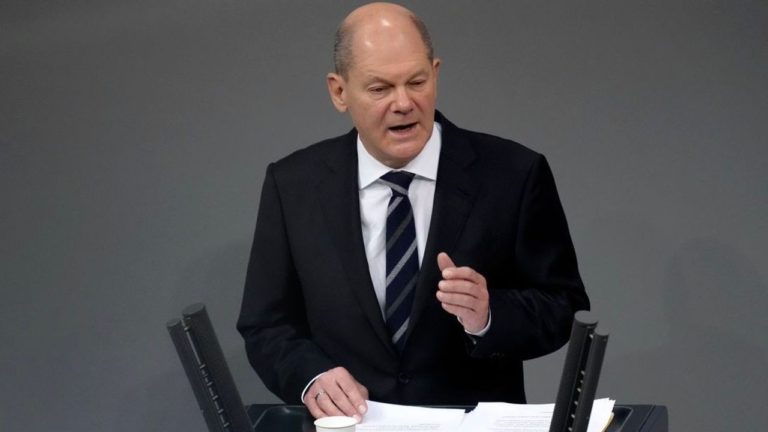
When questioned about the European Union’s timid attitude in Africa while Chinese funds were flowing into the continent to finance development projects, German Chancellor Olaf Scholz brought up again the negative impact that the gargantuan appetite of Chinese lenders could have on global financial stability.
“There is a really serious danger of seeing (the outbreak of) another major debt crisis in the countries of the South linked to loans granted by China, which itself does not have an overall view due to the many actors involved,” the Social Democratic chancellor said during a debate at the Congress of Catholics, held on May 27 in Stuttgart.
“This would plunge China and the countries of the South into a major economic and financial crisis and, moreover, would not spare the rest of the world. This is therefore a serious concern,” he added.
Olaf Scholz also expressed his wish to see China join the Paris Club, an informal group of public creditors whose role is to find coordinated solutions to the payment difficulties of indebted countries by negotiating debt relief or rescheduling. “One of our major ambitions is to integrate China” into this club, he stressed.
China, the leading creditor of the African continent
China has risen in recent years to become Africa’s largest creditor, relying in particular on its two main financial arms (policy banks), namely the Export-Import Bank of China (China EximBank) and the China Development Bank (CDB), as well as on specific bilateral funds such as the China-Africa Development Fund (CAD Fund).
Between 2000 and 2021, the Middle Kingdom poured $161.9 billion into the continent, according to data collected by Boston University.
But some NGOs believe that China’s overall lending commitments are likely much larger. AidData, an international development research organization affiliated with William & Mary University in the United States, notes that nearly 50% of China’s loans to developing countries are not included in official debt statistics.
The American think tank Brookings Institution, for its part, pointed out that the loans granted by China to African countries since the beginning of the new millennium have essentially been used to finance more than 3,000 infrastructure projects.
Global Gateway, a European counter-offensive
Chinese loans are not tied to conditions regarding governance and human rights. However, they are often contingent on awarding contracts to Chinese companies and exploiting local natural resources. And this is where the problem lies. NGOs and Western officials regularly accuse Beijing of using the “debt trap” to exert pressure on its African partners, even forcing them to relinquish control of valuable assets when they can no longer repay.
Zambia, where China has won all international tenders in recent years, and Djibouti, where Beijing has established a military base, for example, have debts to China equivalent to at least 20% of their annual GDP, according to AidData.
But China rejects this argument and accuses Westerners of promoting this narrative to tarnish its image and contain its growing influence.
In any case, the German chancellor’s statements on China’s lending practices in Africa sound like a new episode in the silent struggle for influence between the Asian giant and the West on the continent.
To try and counter Chinese influence in Africa, the European Union unveiled a development aid plan called “Global Gateway” in December 2021. This plan includes investments of €150 billion in Africa over six years to contribute to the development of digital infrastructure, energy, health, and education. This new offensive “made in Brussels” appears to be a European response to the “Belt and Road Initiative,” a colossal project spearheaded by Beijing that envisions the construction of railways, roads, and ports in various parts of the world, particularly in Africa. ( Ecofin Agency )
AlloAfricaNews