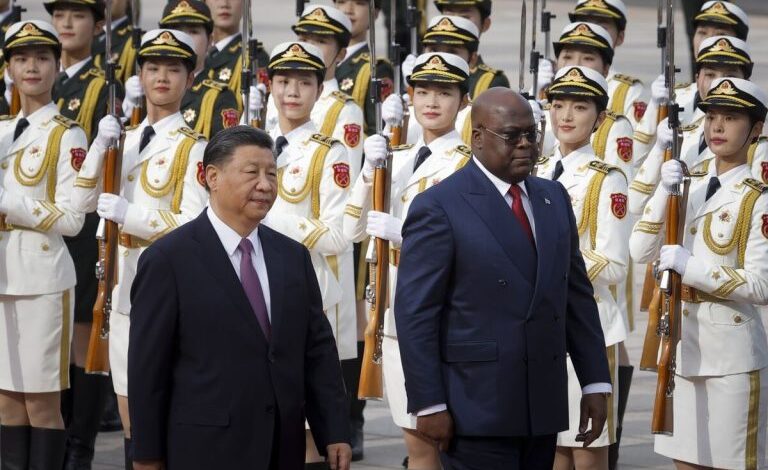
President Tshisekedi is in Beijing to try to renegotiate the mega mining contract with China

President Félix Tshisekedi landed in Beijing on May 24 for his first state visit to China. During his stay, he is expected to discuss the renegotiation of the mega-contract “mines for infrastructure” that has linked his country to China since 2008, and which is considered unfavorable to Kinshasa.
The DRC wants to more than double its stake in Sicomines, the copper-cobalt joint venture with China
In the DRC, the government wants to increase its stake in Sicomines to 70%, up from the current 32%, in this Sino-Congolese joint venture that operates copper and cobalt mines in the country. This issue will be raised by Congolese President Félix Tshisekedi, who arrived in Beijing on the night of Wednesday, May 24, for his first state visit to China.
According to a document seen by Reuters outlining the DRC’s demands in negotiations with the Chinese side, Gécamines would inherit a 60% stake in Sicomines, compared to a 10% stake for the state and 30% for the Chinese companies involved in the agreement. The authorities aim to rebalance an agreement dating back to 2008 that has so far provided little benefit to the Congolese people, according to a report by the General Inspectorate of Finance (IGF).
The institution explained that the Chinese side had invested only $822 million in infrastructure, whereas the “mines-for-infrastructure” contract signed in 2008 stipulated schools, roads, and hospitals worth $3 billion. Meanwhile, its companies reaped $10 billion in profits.
In compensation, the government is expected to claim “a lump sum payment of $2 billion, particularly because Sicomines sold the minerals at half price to Chinese companies […] well below the market price,” says a source, a member of the Commission in charge of drafting the document.
The said Commission, including representatives of the Presidency, the IGF, Gécamines and the Agency for Steering, Coordination and Monitoring of Collaboration Agreements signed between the Democratic Republic of Congo and private partners, also recalls that the 2008 agreement did not fully take into account the value of the copper-cobalt deposits brought by the Congolese side, which is estimated at $90.9 billion.
It should be noted that these demands will be raised by the Congolese head of state during his visit, before talks actually begin between the parties. However, there is no guarantee that Kinshasa will prevail, especially since the conclusions of the IGF report on the contract have already been rejected outright by the Chinese embassy in the DRC.
Denouncing a document “full of prejudice”, Beijing rejected the additional $17 billion in investments demanded by the IGF (bringing the total to $20 billion for infrastructure), stressing that this agreement is a “fine example of a win-win partnership”.
The DRC, however, has a major advantage in these negotiations: the explosion in global demand for copper and cobalt, which makes the country a sought-after partner. In recent months, several of China’s rivals, including the United States and the European Union, have approached Kinshasa to forge agreements regarding the exploitation of the vast Congolese mineral reserves, essential for the energy transition. (Ecofin Agency)
AlloAfricaNews