The Taliban regain control of the situation in Afghanistan

Twenty years after the American and allied invasion, it’s back to square one in Afghanistan: on Sunday, the Taliban seized Kabul and the government collapsed. These events prompted Canada to “temporarily” close its embassy and hastily repatriate its staff.
The Taliban’s entry into the Afghan capital sent shockwaves around the world. On Sunday morning, when announcing the calling of a general election in Canada, Prime Minister Justin Trudeau devoted the beginning of his speech to the issue. “We remain extremely concerned about the situation in Afghanistan,” he stated. “Since this morning, diplomatic personnel have been making their way back to Canada.”
The government says it will resume diplomatic activities as soon as the situation allows it to “guarantee appropriate services and adequate security” for its personnel. Several other countries are also in the process of hastily evacuating their diplomats and citizens.
It’s back to square one.
— Sami Aoun
With little resistance, the Taliban have made a rapid advance across Afghan territory over the past ten days and have seized several major cities. President Ashraf Ghani fled the country on Sunday, shortly before the insurgents arrived in Kabul.
“The Taliban won by the judgment of their swords and guns and are now responsible for the honor, possession, and self-preservation of their country,” Ghani wrote on Facebook. He indicated that he left Afghanistan to avoid a “bloodbath,” because “countless patriots would have been killed” and the capital “would have been destroyed.”
The capture of Kabul is a “rout, a debacle, and a lamentable failure for Western and NATO member countries,” says Sami Aoun, professor at the University of Sherbrooke and director of the scientific committee of the UNESCO Chair in the Prevention of Radicalization and Violent Extremism. “It’s back to square one,” he told Le Devoir in an interview.
The Taliban established the Islamic Emirate of Afghanistan between 1996 and 2001, until the fall of their regime following the “War on Terror” launched by the George W. Bush administration. “In the most optimistic scenario, we hope for a power-sharing arrangement, not a Taliban monopoly,” emphasizes Sami Aoun.
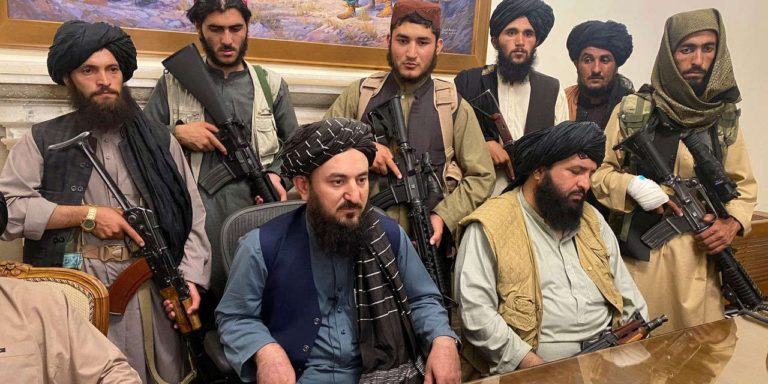
Insurgents stormed the presidential palace on Sunday, according to footage from Al Jazeera. A spokesman, Suhail Shaheen, told the BBC they expected a “peaceful transfer of power” in the coming days.
In response to pleas for help from Afghans fearing for their lives, Canada has decided to repatriate refugees who have supported the Canadian military and diplomatic mission in the country. Justin Trudeau reiterated on Sunday that 20,000 Afghans and their families will be welcomed in the coming months.
But for now, chaos and anxiety reign in Kabul as many have fled to the airport in a panic, and the Taliban have set up checkpoints throughout the city. Nipa Banerjee, an adjunct professor at the School of International Development and Global Studies at the University of Ottawa, believes it will be difficult for the government to fulfill its promise.
“I don’t understand how they’re going to repatriate these 20,000 refugees,” she told Le Devoir, referring to her experience working at the Canadian embassy in Afghanistan from 2003 to 2007. “The ongoing election could make it more difficult operationally; it could take time. It’s going to be very difficult,” she said.
For Mr. Aoun, the willingness of Canada and other Western countries to offer refuge to Afghans is a way to “reassure themselves morally.” “They are mitigating the accusations that they betrayed Afghanistan and its ideals. They have not honored the justification for their right to interfere,” he says.
Resurgence of terrorism?
The collapse of the Afghan government and the return to power of the Taliban raise fears of an acceleration in the consolidation of terrorist groups in the country.
According to several US media reports, the Chairman of the Joint Chiefs of Staff, Mark Milley, said during a conference call on Sunday that previous assessments, which suggested that terrorist groups could reappear in the country within two years, would likely be revised and the timeframe brought forward.
“Al-Qaeda needs weak states, or states that support what the group is trying to achieve, in order to proliferate. Clearly, in Afghanistan, we can see that we are back in a favorable environment,” Shiraz Maher, director of the International Centre for the Study of Radicalisation and Political Violence at King’s College London, told Le Devoir in an interview. “This could become problematic,” he added.
The researcher adds that the Taliban and Al-Qaeda have always had a very strong link. “It remains to be seen to what extent their relationship will be made public,” he says.
During their advance into Afghanistan, the Taliban also released prisoners, which could benefit the Islamic State group, despite the rivalry between the two groups. “Islamic State militants will be released. And we know that this kind of group thrives on chaos and turmoil, as is the case now. They will try to exploit the situation,” Maher concluded. AFP
AlloAfricaNews