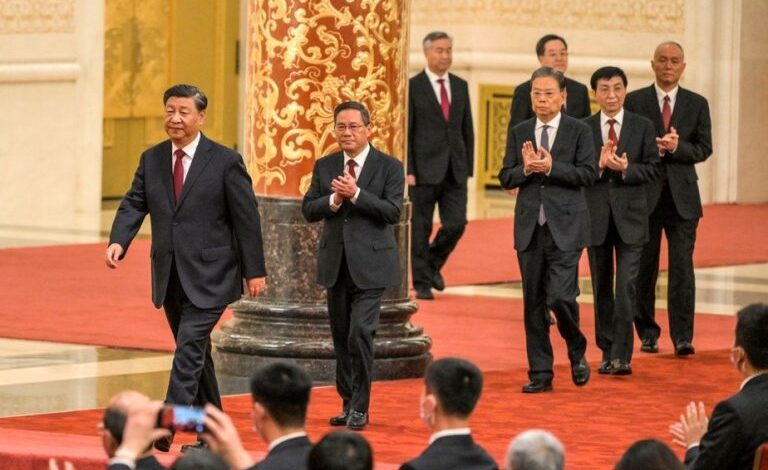
China: President Xi wins historic third term

“China cannot develop without the world and the world also needs China,” the leader, who was also reappointed to head the Chinese army, told the press.
In a decade at the helm of the country, Xi Jinping has strengthened the stature of the world’s second-largest economy and significantly modernized the military to compete with the United States.
“We have created two miracles: rapid economic development and long-term social stability,” he said, after securing a third five-year term through a largely revamped Central Committee of the Chinese Communist Party (CCP).
The Russian and North Korean leaders, Vladimir Putin and Kim Jong-un, sent him their “warmest congratulations.” The former said he was “delighted” to continue “constructive dialogue and close joint work,” while the latter wished for “a brighter future” for bilateral relations between Beijing and Pyongyang.
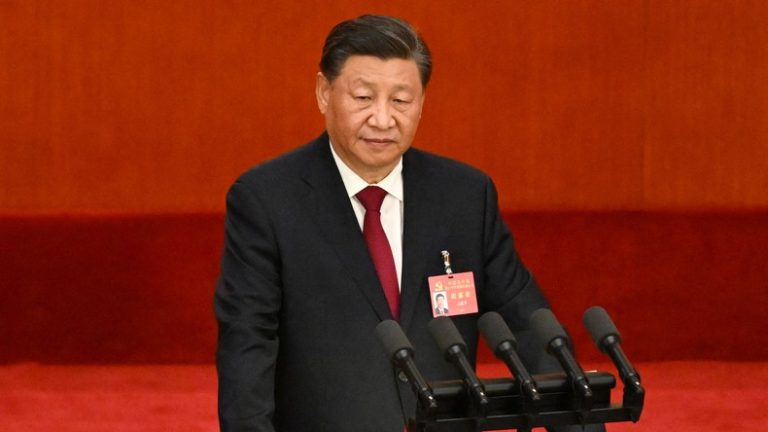
At the Great Hall of the People in Beijing, the 69-year-old leader with an impassive smile arrived at the podium surmounted by the hammer and sickle, followed by six other men appointed to the top of Chinese power, all close associates and allies.
Several foreign media outlets, such as the Wall Street Journal and the BBC, were not invited to this press presentation.
Thanking “the entire Party for [its] trust,” Xi Jinping promised to “work hard in fulfilling” his “tasks.”
Despite an almost total concentration of power, the leader faces headwinds: a sharply slowing economy due to his “zero COVID-19” policy, heightened rivalry with the United States, and international criticism over human rights.
Even fewer women
The 20th Congress of the CCP concluded on Saturday after a week of closed-door deliberations, with the renewal of 65% of the members of the Central Committee, a sort of internal parliament for the party.
During their first meeting on Sunday morning, the 205 members of this parliament — of which only 11 are women — appointed the 24 representatives of the Politburo, the decision-making body of the CCP.
This one, for the first time in 25 years, includes no women.
“Women continue to be severely underrepresented at the highest levels of Chinese politics,” notes the specialized newsletter Neican China. Their proportion has even declined from 5.4% to 4.9% within the Central Committee.
He also appointed the new Standing Committee of the party on Sunday, the body that holds real power in China.
Led by General Secretary Xi Jinping, the Committee is now composed exclusively of his close allies. Li Qiang, the party chief in Shanghai, is widely expected to be the next premier, despite the chaotic handling of the lockdown in the spring. He would succeed Li Keqiang, who is retiring.
The new members of the Standing Committee “are all men of Xi, this shows that he wants to govern beyond a third term,” therefore after 2027, points out Alfred Wu Muluan, an expert in Chinese politics at the National University of Singapore.
“Catastrophic”
This represents a break from the past, when factions within the CCP made compromises to distribute positions, of which Xi Jinping is a prime example: he arrived as a consensus candidate in 2012.
But Mr. Xi then surprised everyone by eliminating his rivals to gradually concentrate all power at the head of the party and China, while carrying out a severe repression against all dissent.
By securing the position of general secretary of the party once again, Xi Jinping is ensuring himself a third presidential term next March.
To maintain his position in power, he amended the Constitution in 2018 which limited this post to two terms and a total duration of 10 years.
“Xi Jinping’s reappointment is the result of an extreme concentration of his personal power,” a Chinese political scientist told AFP, speaking on condition of anonymity due to the sensitivity of the subject.
And there is “no doubt” that Mr. Xi is now seeking to remain in power for life.
This decision is “catastrophic for China” and harms the Communist Party, this intellectual believes, because it heralds, in his view, “the decline and stagnation” of the world’s second largest economy.
Henry Gao, a law professor at Singapore’s Management University, predicts that Xi will be “more conservative” in domestic policy but “more radical” internationally during his next term: he will “try to confront the West.”
The Hu Jintao incident
At the close of its congress, the CCP reaffirmed on Saturday the “central role” of Xi Jinping.
The only notable incident during the highly choreographed ceremony occurred when former president Hu Jintao was escorted out, AFP journalists observed. Apparently against his will, the 79-year-old, who led China from 2003 to 2013, was urged by staff to rise from his seat, located next to Xi Jinping.
This highly unusual scene has not been explained by the authorities, who have not responded to requests from AFP.
The Xinhua news agency reported in English that Hu Jintao “was not feeling well.” He is now “much better,” it wrote on Twitter, which is blocked in China. However, no media outlet in the country has picked up this report. AFP
AlloAfricaNews