The Dutch Prime Minister issues a formal apology for slavery

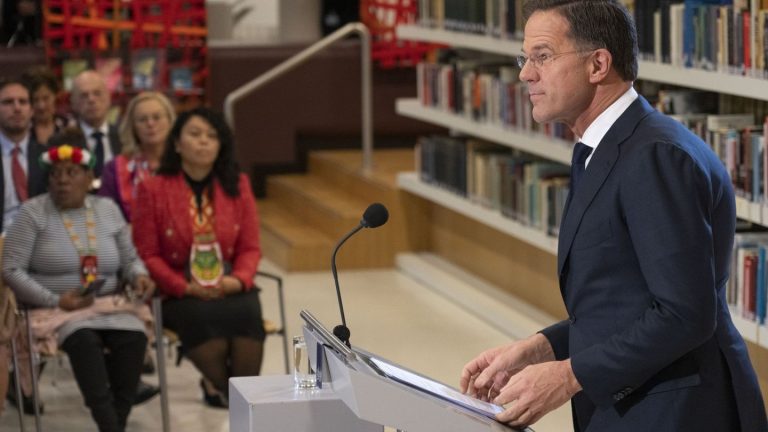
Dutch Prime Minister Mark Rutte on Monday in The Hague offered the government’s official apology for the Dutch state’s role in 250 years of slavery, which he described as a “crime against humanity.”
The apology was hailed as a “turning point in the history of the Dutch kingdom.” But the lack of concrete action from the government was lamented in Suriname, and the prime minister of Sint Maarten criticized the Netherlands’ lack of dialogue.
“Today, I apologize on behalf of the Dutch government for the actions of the Dutch state in the past: posthumously to all the slaves around the world who suffered because of this act, to their sons and daughters, and to all their descendants,” said Mr. Rutte. At the same time, several of his ministers were in seven former colonies, in Suriname and the Caribbean, to discuss the issue with the local populations.
“People have been turned into merchandise. Human dignity has been trampled underfoot in a horrible way,” added Mr. Rutte, before saying “I am sorry” in English, Sranan (Surinamese Creole) and Papiamento (Netherlands Antilles Creole).
“I don’t notice much about the Netherlands’ actions and that’s a shame,” Iwan Wijngaarde, president of the Federation of Afro-Surinameses in Paramaribo, told AFP.
“What was completely lacking in this speech was responsibility and accountability,” Armand Zunder, president of the Suriname National Reparation Commission, told AFP, while noting that the recognition was clear.
The government has promised several major commemorative events starting next year, and announced a fund of 200 million euros for social initiatives.
“We believe that eventually there should be a fund that will amount to billions,” said Mr. Zunder.
Controversial
Evelyn Wever-Croes, Prime Minister of Aruba, a small island in the Dutch Antilles, hailed a “turning point in the history of the kingdom” to the Dutch news agency ANP.
But the government’s willingness to apologize on Monday, which had been leaked to the Dutch press, had been causing intense controversy in the Netherlands and overseas for several weeks.
Slavery commemoration organizations wanted these apologies to be presented on July 1, 2023, the date marking 150 years since the end of slavery.
Some are also demanding compensation.
Sint Maarten’s Prime Minister, Silveria Jacobs, on Monday regretted the “forced apologies” but invited the Netherlands to dialogue.
“We are not at the stage where we can accept or reject statements/apologies,” she told public broadcaster NOS.
“I think an apology should be offered to Suriname,” also reacted Sangita Kalloe, a teacher in Paramaribo.
“Golden Age”
Slavery helped finance the Dutch “Golden Age,” a period of prosperity fueled by maritime trade in the 16th and 17th centuries. The country traded approximately 600,000 Africans, primarily to South America and the Caribbean.
At the height of its colonial empire, the United Provinces, known today as the Netherlands, possessed colonies such as Suriname, the Caribbean island of Curaçao, South Africa and Indonesia, where the Dutch East India Company was based in the 17th century.
Slavery was formally abolished in Suriname and other territories held by the Dutch on July 1, 1863, but did not truly end until 1873 after a 10-year “transition” period.
Dutch ministers were in the Caribbean islands on Monday: Bonaire, Sint Maarten, Aruba, Curaçao, Saba and Saint Eustatius, and in Suriname.
In recent years, the Netherlands has begun to confront its role in slavery. The cities of Amsterdam, Rotterdam, Utrecht, and The Hague have officially apologized.
Mark Rutte has long been reluctant to issue a formal apology, arguing in the past that the period of slavery was too long ago and that an apology would inflame tensions in a country where the far right remains strong.
“I was wrong,” he admitted on Monday, even though a recent poll showed that barely 38% of the adult population supported an official apology.
“Centuries of oppression and exploitation affect the present, in racist stereotypes, discrimination, and social inequality,” he added. AFP
AlloAfricaNews